
Buy Alentejo wine: spicy to powerful wines from southern Portugal
Cross the Tagus (Tejo) in Lisbon and you reach the land 'beyond' (além) the Tagus: the Alentejo. In this rolling landscape of cork oaks and olive trees, around a fifth of all Portuguese wine is made.
It is hot here, and many wines are too ripe for our taste. We choose the exceptions, often from places with a milder climate. Since 1999, The Portugal Collection has offered Alentejo wines from producers including Quinta do Mouro, Terrenus and XXVI Talhas, imported directly and delivered throughout Belgium.
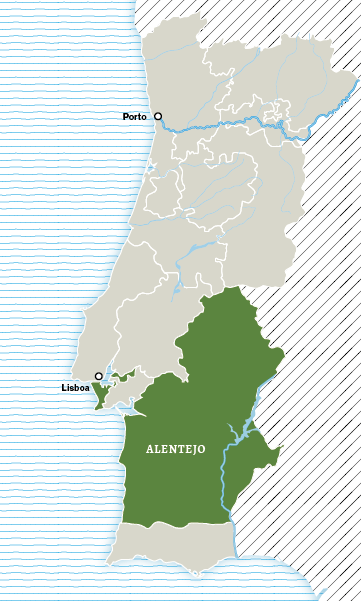
The Alentejo at a glance
| Location | Southern Portugal, from the Tagus to above the Algarve, over some 250 km |
|---|---|
| Climate | The hottest in Portugal, with big differences between the cooler north (Portalegre) and the hot south (Beja) |
| Appellation | DOC Alentejo, first DOC recognised in 1988 |
| Size | Some 20,000 ha of vineyards, 260 producers, 1,170,000 hl a year |
| Colour | 80% of production is red wine |
| Red grapes | Alfrocheiro, Alicante Bouschet, Aragonez, Castelão, Touriga Nacional, Trincadeira, Syrah, Cabernet Sauvignon |
| White grapes | Antão Vaz, Arinto, Fernão Pires, Rabo-de-Ovelha, Roupeiro (Síria) |
| Tradition | Wine fermented in large terracotta amphorae (talhas de barro), since Roman times |
Our style: spicy to powerful
There is no doubt the Alentejo is hot. It mainly produces sun-drenched wines that are often a little too ripe for our taste. Still, a few exceptions are well worth it, and it is no coincidence that they come from places where temperatures are milder. Our Alentejo wines have a spicy to powerful style.
Location
This vast area is bounded to the north by the Tagus, which enters Portugal from Spain just above the Serra de São Mamede and flows into the ocean just below Lisbon. The whole area below it, over a distance of 250 km, is the Alentejo.
Although it is broadly the hottest region in Portugal, temperatures vary considerably from north to south. Around the southern town of Beja, July and August average almost 25 °C, with peaks above 45 °C. In Portalegre in the north, maximums rarely exceed 40 °C and the summer average is a full degree lower. For wine, that makes a big difference.
Winegrowing has a long history here and the region is clearly on the rise: 1,170,000 hl a year, most of it (46%) drunk in Portugal itself. 80% is red wine, which makes sense in this hot climate.
History: the talha tradition
Nobody knows exactly when winegrowing began, but domesticated vines existed even before the Phoenicians arrived. The Greeks left many traces with their small amphorae, but it was the Romans who left the biggest mark, with large terracotta amphorae (talhas de barro) in which the grape juice was fermented.
The arrival of the Moors almost wiped out winegrowing, but the tradition of making wine in amphorae survived, while it was lost in the other Portuguese regions. Over the centuries, wine production went through periods of success and crisis. After phylloxera and the world wars of the 20th century, vineyards were often replaced by other crops, until winegrowing regained importance from the 1980s.
The first DOC was approved in 1988 and, as everywhere in southern Europe, many new projects were launched with EU funding. Today there are some 260 producers and around a hundred merchants, covering 20,000 ha, just over half of which is DOC.
Grape varieties
Red DOC wine must consist entirely or at least 75% of Alfrocheiro, Alicante Bouschet, Aragonez, Cabernet Sauvignon, Castelão, Syrah, Touriga Nacional or Trincadeira. Around 25 other native and international varieties are also permitted, up to 25% in total.
White DOC wine must consist entirely or at least 75% of Antão Vaz, Arinto, Fernão Pires, Rabo-de-Ovelha, Roupeiro (Síria) and a few rarely planted varieties. Around 30 other varieties are allowed in smaller proportions.
Our Alentejo producers
Quinta do Mouro
From Vinha do Mouro to Quinta do Mouro, Vinha da Gafaria, Erro and Dourado.
About Quinta do Mouro · All Quinta do Mouro wines
Terrenus
Red and white Alentejo from Portalegre, including Vinha da Ammaia Amphorae, Vinha da Serra and Vinhas Velhas Reserva.
All Terrenus wines
XXVI Talhas
Wines from the talha, the traditional amphora: Mestre Daniel, Talha X, Tinto and Palhete do Tareco.
Mestre Daniel · Tareco
More Alentejo
Also Intus, NaTalha, Natus, Intensus, Zagalos, Farrapo and Desfarrapo, plus Hortas and Dominó Salão Frio by Vitor Claro.
View the full range
Read more about Hamilton Reis (Natus Vini), Gerações da Talha and Vitor Claro.
View all Alentejo wines in the webshop
Delivery and collection
We deliver throughout Belgium. Shipping costs €15.73 (incl. VAT) and is free from €175. Prefer to collect? You can pick up your order at our shop in Roeselare, Kaaistraat 62A. More about delivery
Frequently asked questions about Alentejo wine
Where can you buy Alentejo wine in Belgium?
Since 1999, The Portugal Collection has specialised in Portuguese wine and imports Alentejo wines directly from producers such as Quinta do Mouro, Terrenus and XXVI Talhas. Order online with delivery throughout Belgium, or collect in Roeselare.
What is talha wine?
Wine fermented in large terracotta amphorae, the talhas de barro. The Romans brought the technique to the Alentejo, and it is the only Portuguese region where the tradition has continued unbroken.
Are Alentejo wines always heavy?
Many are, because of the hot climate. We deliberately choose wines from cooler spots, such as around Portalegre in the north, with a spicy to powerful yet balanced style.
Which grapes are used in the Alentejo?
For reds mainly Alicante Bouschet, Aragonez, Trincadeira, Castelão, Alfrocheiro and Touriga Nacional. For whites Antão Vaz, Arinto, Fernão Pires, Rabo-de-Ovelha and Roupeiro.
Discover our other Portuguese wine regions too: Douro, Dão, Bairrada, Vinho Verde, Lisboa and Porto.