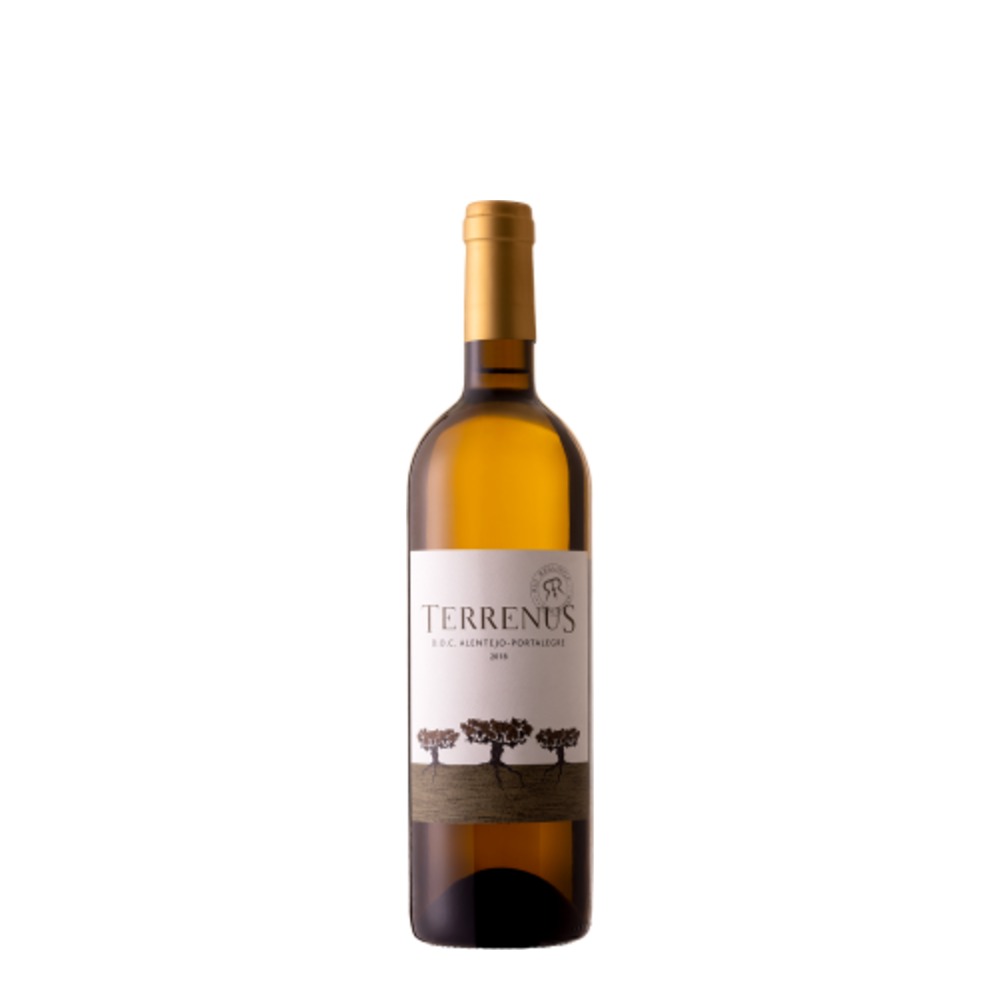
Terrenus branco 2022
Region: Alentejo
Producer: Rui Reguinga
Rui immediately saw the potential and especially felt that the combination of the place and the grapes could give him a wine that was in the spirit of the northern Rhone he loved so much. Rui had always had a weakness for the better Roussanne and here in Portalegre he could make a Portuguese version of it.
| Volume | 75.0 cl. |
| Grape Variety | field blend |
| Drinking window | 2023-2028 |
| Alc. | 13.0% |
| Vinification | partially in stainless steel tanks and partially in oak barrels |
| Ripening | in used oak barrels |
Waar serveer je ’m bij?
Rui Reguinga was the pioneer of Portalegre, the sub-region that is now on everyone's list: the most northerly part of the Alentejo and, because of its altitude, the coolest. A field blend with Arinto and Fernão Pires, fermented partly in steel and partly in oak, and aged in used barrels. Weight eleven with a high acidity underneath — that is the combination Portalegre makes possible and that does not exist in the rest of the Alentejo.
Risotto with tomato and basil
Lamb sausages with cumin
Serveren op 11–13 °C
Drink: 2025–2028
“The white 2022 Terrenus Branco, which carries mentions like "Serra de São Mamede" and "Vinhas de Altitude" on the label, was produced with a mix of local varieties from old vines—Arinto, Fernão Pires, Roupeiro and others—on schist soils. It fermented in stainless steel with neutral yeasts and was kept with the lees for four months. It has an expressive and serious nose with some reductive hints of gunpowder, yeasts, dry yellow flowers and herbs and a citrus and somewhat exotic touch. It's round, juicy and tasty, with an almost salty twist in the finish. It's quite serious for an entry-level wine and at a very attractive price. It comes in at 13% alcohol, with a pH of 3.2 and 6.2 grams of acidity. 10,000 bottles produced. It was bottled in April 2023.”

Rui Reguinga was born into a family of winemakers and absolutely wanted to follow in their footsteps. He graduated as an oenologist in the late 1980s and immediately made his first wines in Alentejo.
More about Rui Reguinga →