Lisboa is perfect for a city trip, but if you stay longer than a few days you may want to escape the bustle for a while. The N6 coastal road (or the railway that runs parallel to it) is then the ideal route. Head west from Cais do Sodré and you'll soon experience the European, Atlantic equivalent of the famous and spectacular Highway 1 that takes you from Los Angeles along the Pacific towards San Francisco.
Before the road opens up completely towards the ocean, a broad avenue first takes you past the hip Santos district and the harbour area. Perhaps a little early to stop for a bite and a drink, but do keep Comida Independente in mind for when you're back in town. After a walk through the lively streets of the district and perhaps a visit to the Museum of Ancient Art (worth it for one of Hieronymus Bosch's triptychs alone), you can eat small dishes at Comida in an airy setting, accompanied by a good glass of naturally made wine. The selection by the glass and by the bottle is impressive.
A little further on you come to a classic you can't pass by, despite the tourist crowds. Pastéis de Belém has been making Portugal's most famous pastry since 1837. And even though production sometimes rises to 40,000 (!) a day in the busy summer months, the quality remains unrivalled. In 25 years of Portugal, I've never known anyone to better combine the right crispness of the pastry with the creaminess of the custard inside.
Beyond Belém, the Tagus flows into the ocean and the view widens. You soon drive into Carcavelos. That name may ring a bell with wine lovers. It is indeed a small appellation that was once famous for its fortified wines, a bit like port, but less sweet thanks to the Atlantic influence. As Lisboa urbanised, most of the vineyards were lost, but the local council eventually managed to safeguard 9 ha. Recently the first bottles of a new generation of Carcavelos came onto the market. For our taste it could all be a bit drier, but the quality is certainly good. On a visit, the setting more than makes up for it. The wines are made in the old palace of the Marquês de Pombal, and while tasting you can see the sea in the distance. On the website of Villa Oeiras you can request a visit.
Next stop is Estoril. There, the stately villas and the grandeur of the Palácio Hotel recall the time when kings went into hiding there from the violence of the Second World War. That the local casino was later said to be a meeting place for spies inspired Ian Fleming to write Casino Royale.
The atmosphere becomes truly glamorous as you drive into Cascais, which is also the terminus for those who came by train. But the best is yet to come, so another means of transport is called for. Cycling is highly recommended if you can handle the wind; otherwise there are plenty of Ubers. The lively centre and beach of Cascais gradually give way, via the marina, to a rougher stretch of coast with cliffs. What follows leaves few people unmoved. For years, marketers have favoured the area for launching new car models against a backdrop that makes you dream of freedom.
By now a lunch with some proper fish is in order. If you want a terrace with an ocean view, stop at Furnas do Guincho or Monte Mar. If you're going all out for quality, round the cape of Guincho and choose Porto Santa Maria: top-class fish, but no terrace. In the glass, a fine Alvarinho is a must anyway: the ideal refreshment and a perfect match for grilled fish. In all these restaurants you'll find the better bottles from producers such as Soalheiro and Anselmo Mendes on the list. At all three, booking ahead is recommended.
After the meal, the N247 takes you north into the hills of Sintra. The views are breathtaking, and afterwards the forests provide coolness on hot days. The whole forest is a nature reserve that will keep experienced walkers busy for a while. A walk along the cliffs from Cabo da Roca, the westernmost point of mainland Portugal, is also recommended. Those with the courage for plenty of climbing and descending can walk all the way to the beautiful beach of Adraga.
Prefer to rest after lunch? Then consider Praia Grande in Colares. You won't see many tourists here because there can be some mist, but the place has character and the surfers out at sea provide a spectacle.
If you have enough time, definitely consider one or two nights in the area. The Arribas Sintra Hotel is ideal for that. It isn't the poshest hotel in the world, but it has a nice retro feel, a never-boring ocean view from every room and an Ocean Pool no less than 100 metres long. Take your teenagers there and you'll struggle to leave.
In the late afternoon it's time to head for Azenhas do Mar. You can while away the time at the tidal pool before having dinner at Restaurant Azenhas do Mar (where you absolutely must book in advance).
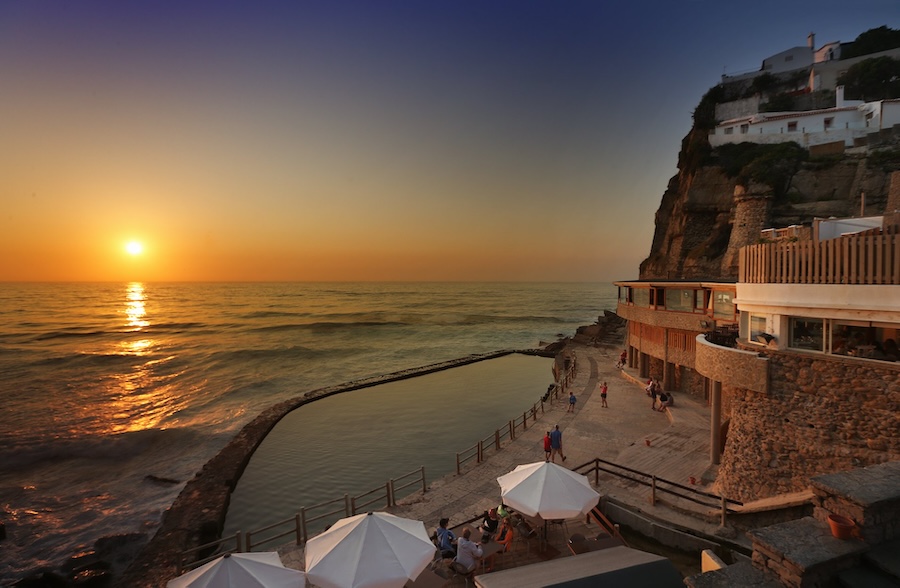 sunset @ Azenhas do Mar
Head back to Lisboa via Colares. This village has cult status among wine lovers, because the wine of the same name can be of exceptional quality. I deliberately say 'can', because unfortunately the local commission once decided that only the village cooperative had the right to turn grapes into wine; private companies could then buy the young wine, age it in their cellars and market it under their own name.
Since quality isn't always the top priority in a cooperative, the results could be very disappointing, all the more so because the growing conditions in the region are quite challenging.
But when it was good, it was very good indeed. In Colares the vines are planted in dune sand, sometimes just a few hundred metres from the coast. Conditions don't get more Atlantic than that. In the best years this can result in wines that, after long bottle ageing, display fantastic complexity in the glass.
The ageing potential of the best Colares is almost endless. Bottles from the 1950s and 1960s are showing at their best today. That has everything to do with the high acidity the wines get from the cool growing conditions. As a result, ten years or more of ageing is practically a minimum.
From Colares you'll quickly reach Sintra. Be sure to set aside enough time for a tour of the palaces hidden here and there in the wooded hills. The best known, and rather crowded, is of course the colourful Palácio Nacional da Pena, which you can often already see from the plane when arriving in Lisboa. But further west lie much quieter palaces and quintas that are just as worthwhile.
Finally, halfway back to Lisboa, you can stop at the Palácio de Queluz and the remains of the Antigo Canal. That way you'll also know the origin of the imposing aqueduct you can't miss on the ring road around Lisboa. In the 18th century the aqueduct supplied drinking water, because the city of Lisboa had no water sources of its own.
And after such a lively outing you've earned a good glass of wine, at Black Sheep on Praça das Flores, for example. There you'll find many wines from the coastal region of Lisboa, and of course we can deliver them to you as well.