In the early 2000s I was standing in Marcel Lapierre's courtyard in the spring sunshine. He had me taste three versions of his Morgon. That tasting became one of the most decisive of my wine life.
Three times the same wine
The first cuvée was natural: unfiltered and without sulphites. You only got it if you came with refrigerated transport that kept the wine below 14 °C. The second was légèrement sulfité and unfiltered; you got that one if you had not arranged cooling. The third was sulphited and filtered.
The difference was immense. You could see the energy drain away as we moved towards the most processed wine. The third gave only a fraction of the sensational experience of the first. 'Le troisième, c'est pour les Américains,' Marcel said with a wink.
It was the same wine, from the same grapes and the same cellar. The only difference was what happened after fermentation. Since then I look differently at what is in a bottle, and above all at what is not.
Who was Marcel Lapierre?
Lapierre made wine in Morgon, in Beaujolais. In the late 1970s he came under the spell of his neighbour Jules Chauvet: winemaker, merchant and scientist. Chauvet studied how fermentations behaved with and without sulphites, farmed his vineyard organically and fermented spontaneously, without additives. Lapierre followed that approach, together with winemaker friends such as Jean Foillard, Jean-Paul Thévenet and Guy Breton, later called the 'gang of four'. In the early 1980s their wines found their way to the wine bars of Paris, and from there to the rest of France and the world. Chauvet is now regarded as the grandfather of natural wine.
Why the movement was needed
After the Second World War, viticulture switched en masse to synthetic pesticides and fertilisers. That had consequences in the cellar too. If you get grapes from an exhausted vineyard, you have to correct: with selected yeasts, plenty of sulphur, sugar and a whole range of permitted additives. Natural wine is a reaction to exactly that. If the grape is healthy, you need none of it.
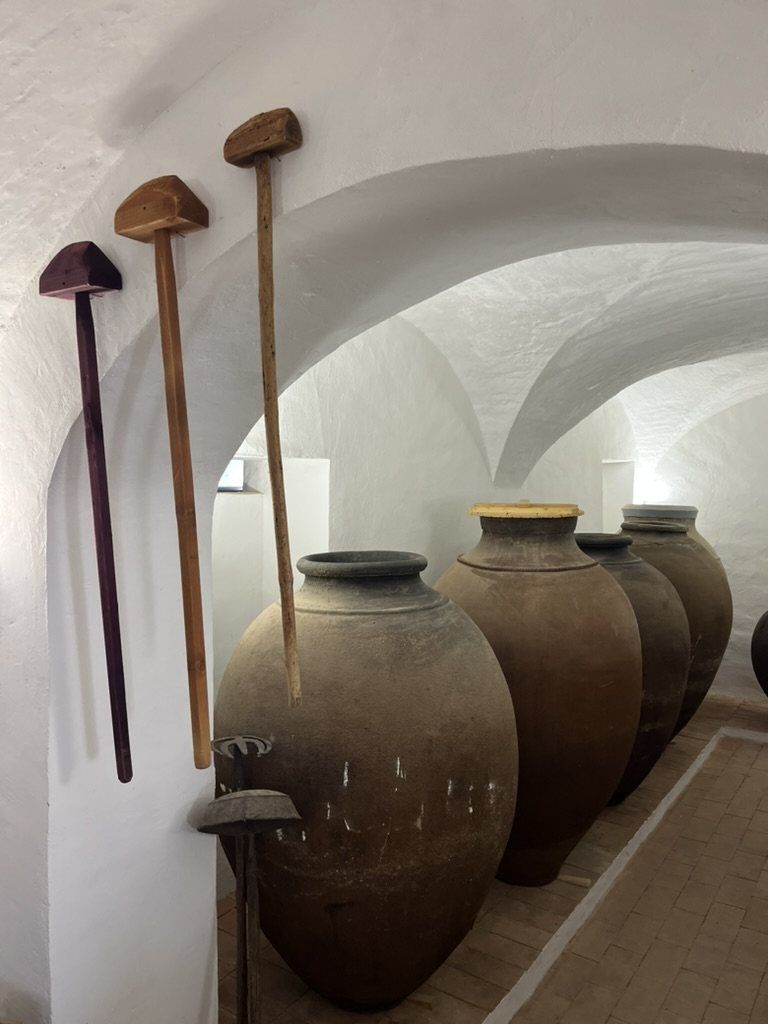
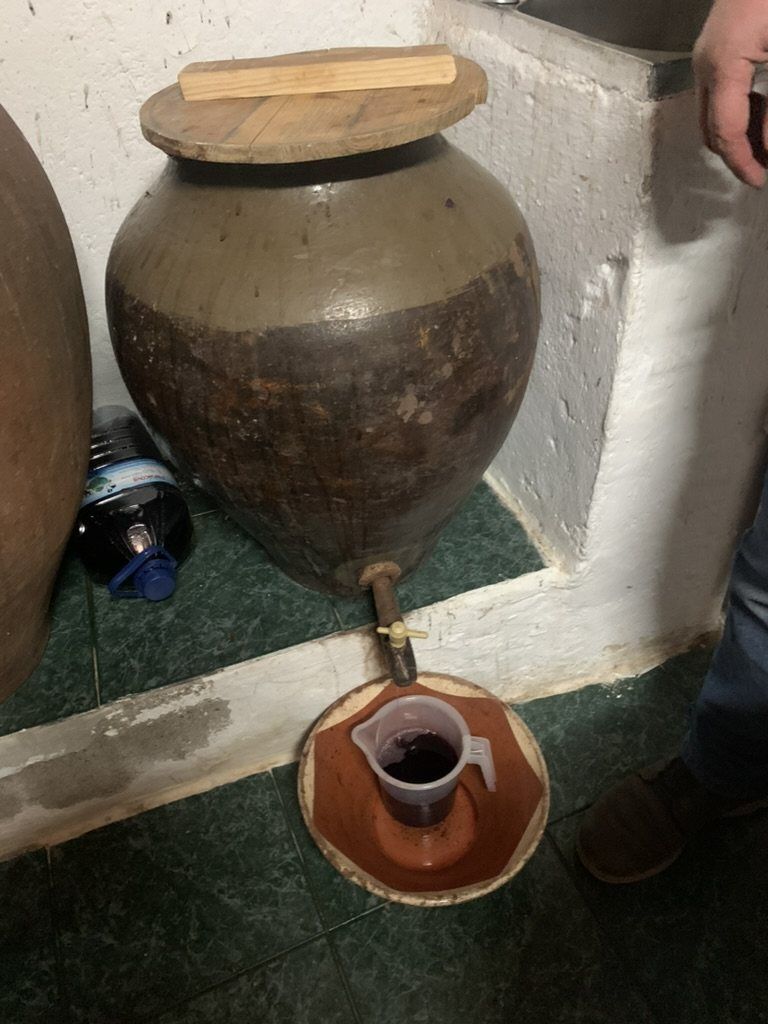
Making wine the old way: in talhas, clay jars, without additives.
Organic, biodynamic and natural: what is the difference?
Organic is first and foremost about the vineyard: no synthetic pesticides or fertilisers. To support the vines, only substances that occur in nature may be used. In practice, the arsenal is therefore largely limited to copper and sulphur. Copper protects the vine against downy mildew, sulphur against powdery mildew. The problem with copper: it is a heavy metal that does not break down. It builds up in the soil and harms earthworms and other soil life. That is why, since 2019, the EU has allowed no more than 28 kg of copper per hectare over seven years, an average of 4 kg a year. Rain also washes copper off, so in wet years the vines often have to be sprayed again. It is regulated by law and certified, and since 2012 the EU has also had rules for organic wine in the cellar.
Biodynamic goes further. It is always organic, but sees the vineyard as a living whole, ideally with animals, and works with preparations based on herbs and minerals and with a calendar that follows the position of the moon and planets. It goes back to Rudolf Steiner (1924), which makes it older than organic farming. Science cannot conclusively explain why it works, but estates such as Leflaive, Leroy, Huet and Romanée-Conti now use it.
Natural wine is about the cellar. There is no legal definition, but the basics are always the same: organic, hand-picked grapes, spontaneous fermentation and nothing added, apart from at most a little sulphur. No filtering, no correcting. Since 2020 France has had the Vin Méthode Nature label, recognised by the INAO.
Biodynamics up close: Filipa Pato and William Wouters
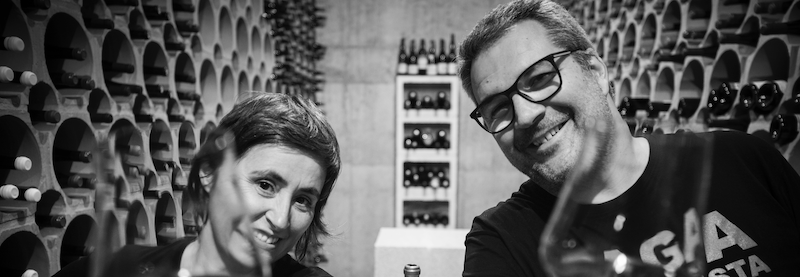
I have seen most clearly what biodynamics does to a wine at Filipa Pato and William Wouters, in Bairrada. I have known their wines from the very beginning: I was on her father Luis Pato's doorstep when Filipa still had to bottle her first vintage, 2001.
When William and Filipa decided to convert, I could follow the process up close: first two years of conversion to organic, then another two years until the Demeter certification was complete. Since the 2024 harvest the Demeter logo has been on their bottles. Because I have known their wines for so long, I could also taste the impact clearly. The Nossa wines, the result of that biodynamic approach, clearly have more layers. There is more flavour in them, and more life.
That has not been scientifically proven, and it will not be easy to prove. But it is striking how many of the most respected estates in the world, from Leroy to Romanée-Conti, farm biodynamically.
To be fair
Natural wine is not automatically good wine. Without sulphites a wine is more fragile, and some enthusiasts have come to accept things that used to count as faults, such as volatile acidity or the mousy taint that appears more often with little sulphur. That is exactly why Lapierre only let his natural cuvée go with refrigerated transport: without protection, the wine has to stay cool. Done well, it makes sensational wine. Done sloppily, 'natural' becomes an excuse.
What it brought the wine world
Its influence reaches far beyond natural wine itself. You see it in winemakers who would never call themselves 'natural': less new oak, less sulphur, lower alcohol, light reds you can serve chilled, whites fermented on the skins, pét-nat. And in the vineyard: far more organic, biodynamic and regenerative farming.
The same movement also sparked interest in old, mixed vineyards. I wrote about that in Field blends: why the old Portuguese vineyard is modern again.
In our range
In Portugal, too, more and more winemakers are taking this path, each in their own way.
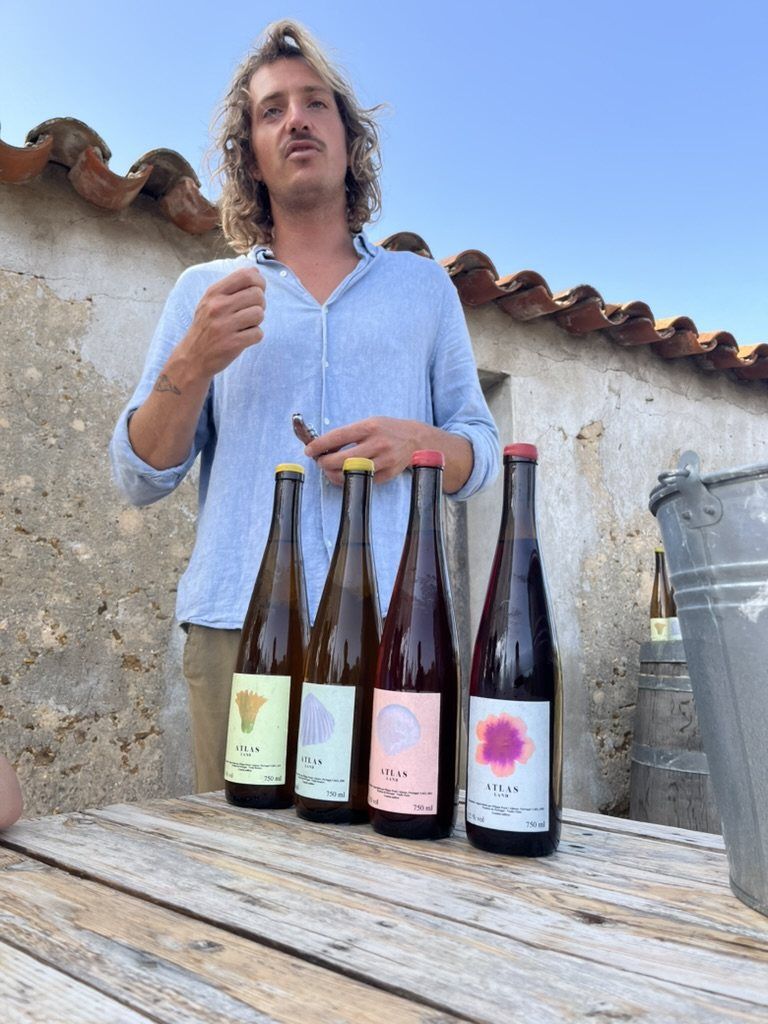
Natural, in the vineyard and in the cellar. Atlas, Beiorte, Marinho by Luis Gil and Safado make natural wine. At Humus fermentation also happens without added yeasts or enzymes, Menina d'Uva works with natural yeasts and Natus Vini lets the fruit speak without intervening.
Natural in the vineyard, more classic in the cellar. Luis Seabra and Jorge Moreira of Poeira are fully committed to very old plantings, which they farm without chemicals. In the cellar, though, they stay more conventional.
Biodynamic. Filipa Pato and William Wouters carry the Demeter logo, and Niepoort is also applying biodynamics in more and more of its vineyards. Niepoort's Nat' Cool range in turn stands for light, easy-drinking wine with minimal extraction.
Sources
- The Oxford Companion to Wine, via JancisRobinson.com: entries natural wine and biodynamic viticulture.